Berg Balance Scale (BBS): scoring, cut-offs and a printable score sheet
2026-10-22 · 11 min read
14 tasks, each scored 0 to 4, for a total out of 56. Here is how each item is scored, which cut-off fits which patient, how big a change has to be before it counts, and a score sheet you can fill in and print.
Berg Balance Scale in one screen
14
items, sitting to single-leg stance
0–4
per item, lowest level that applies
56
maximum total
≤ 50
fall-risk flag in older adults
The Berg Balance Scale (BBS) is a clinician-rated test of sitting and standing balance, static and dynamic. The patient performs 14 everyday tasks, from rising out of a chair to standing on one leg, and you score each one from 0 to 4. Points come off for needing supervision, needing hands-on help, or running past the allotted time. The total is out of 56; higher is better. It takes under 20 minutes once you have run it a few times.
It is the balance measure the neurologic PT core-measures guideline recommends for tracking change in static and dynamic sitting and standing balance, one reason it turns up in evaluations well beyond neuro caseloads.
Berg balance score sheet (printable)
Score the items as you go. The total, the comparison with independent adults of the same age and sex, and the change you need on a re-test update with every tap. Print gives you the sheet alone.
Berg balance score sheet
Pre-filled with an example first test. Pick the lowest level that applies on each item.
1.Sitting to standing
Stand up from a chair with armrests, hands off if possible
Stands without hands, steadies alone
2.Standing unsupported
Stand 2 minutes without holding on
2 min safely
3.Sitting unsupported
Sit 2 minutes, back free, feet supported, arms folded
2 min safely and securely
4.Standing to sitting
Sit down into a chair with armrests
Sits safely, minimal hand use
5.Transfers
Pivot from a chair with armrests to one without, and back
Safe, minor hand use
6.Standing, eyes closed
Close the eyes and stand still for 10 seconds
10 s safely
7.Standing, feet together
Place the feet together and stand 1 minute
1 min safely
8.Reaching forward
Arms at 90°, reach forward as far as possible against a ruler
12 cm (5 in) safely
9.Picking up an object
Pick up a slipper or shoe placed in front of the feet
Picks up safely and easily
10.Looking behind
Turn to look behind over the left, then the right shoulder
One side well, other less shift
11.Turning 360°
Turn a full circle, pause, turn back the other way
One direction in ≤ 4 s
12.Alternate foot on a step
Touch each foot to a step or stool, four times each
4 touches, supervised, no aid
13.Tandem stance
One foot directly in front of the other, hold 30 seconds
Small step alone, holds 30 s
14.Standing on one leg
Stand on one leg as long as possible, no hands
Tries, < 3 s, stays standing
46 / 56
14 of 14 items scored
- Independent, community-dwelling women aged 80–89 averaged 50 (95% CI 49–52). This total is 4 points below it.
- Inside the Lusardi 2017 fall-risk range (≤ 50).
- Outside the Berg 1992 fall-risk range (< 45).
- On a re-test, a change of 4 points or more is real change for an older adult starting here (Donoghue 2009).
The 14 items and how each is scored
The levels below are our short wording of the published scoring, for scanning at the plinth. Read the patient the standardized instruction from the ANPT protocol, word for word, every time: the test is only comparable across visits and raters if the instructions are.
| # | Item | Scores 4 | Scores 0 |
|---|---|---|---|
| 1 | Sitting to standing | Stands without hands, steadies alone | Moderate or maximal assist |
| 2 | Standing unsupported | 2 min safely | Cannot stand 30 s unsupported |
| 3 | Sitting unsupported | 2 min safely and securely | Cannot sit 10 s unsupported |
| 4 | Standing to sitting | Sits safely, minimal hand use | Needs help to sit |
| 5 | Transfers | Safe, minor hand use | Two people, or supervision for safety |
| 6 | Standing, eyes closed | 10 s safely | Needs help to avoid falling |
| 7 | Standing, feet together | 1 min safely | Needs help into position, < 15 s |
| 8 | Reaching forward | 25 cm (10 in) confidently | Loses balance or needs support |
| 9 | Picking up an object | Picks up safely and easily | Cannot try, or needs assist |
| 10 | Looking behind | Both sides, good weight shift | Needs assist to stay up |
| 11 | Turning 360° | Both directions in ≤ 4 s each | Needs assistance |
| 12 | Alternate foot on a step | 8 touches in ≤ 20 s, safely | Needs help or cannot try |
| 13 | Tandem stance | Full tandem alone, holds 30 s | Loses balance stepping or standing |
| 14 | Standing on one leg | Holds > 10 s | Cannot try, or needs assist |
Two shortcuts the protocol allows
If the patient stands the full time on item 2 without support, give full points for item 3 and go straight to item 4. On items 13 and 14 the patient picks the leg; with a one-sided impairment, test the involved leg in single-leg stance and step forward with the uninvolved one in tandem.
Equipment and setup
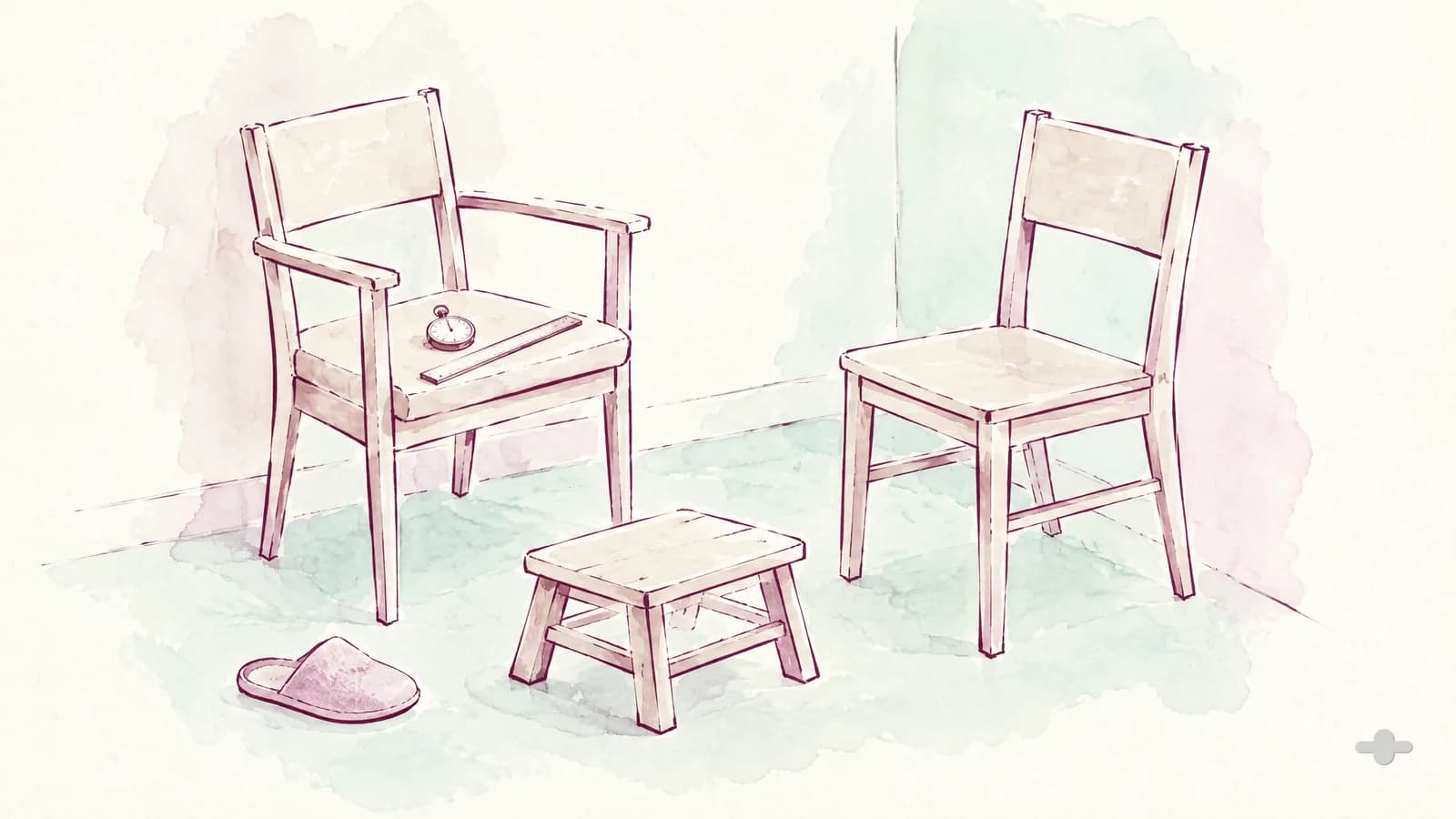
You need a stopwatch, two standard-height chairs (18–20 in), one with armrests and one without, a step or stool of 7¾–9 in, a ruler and a slipper or shoe. A plinth or bed can stand in for one chair if you keep it near the standard height, or note the height you used and use it every time.
- No assistive device. Ask the patient to try each item without the cane or walker. An item they cannot do without it scores 0.
- Touching assistance takes the lowest level that names it. Guard with a gait belt if you must, then consider a second trial without your hands on for a true score.
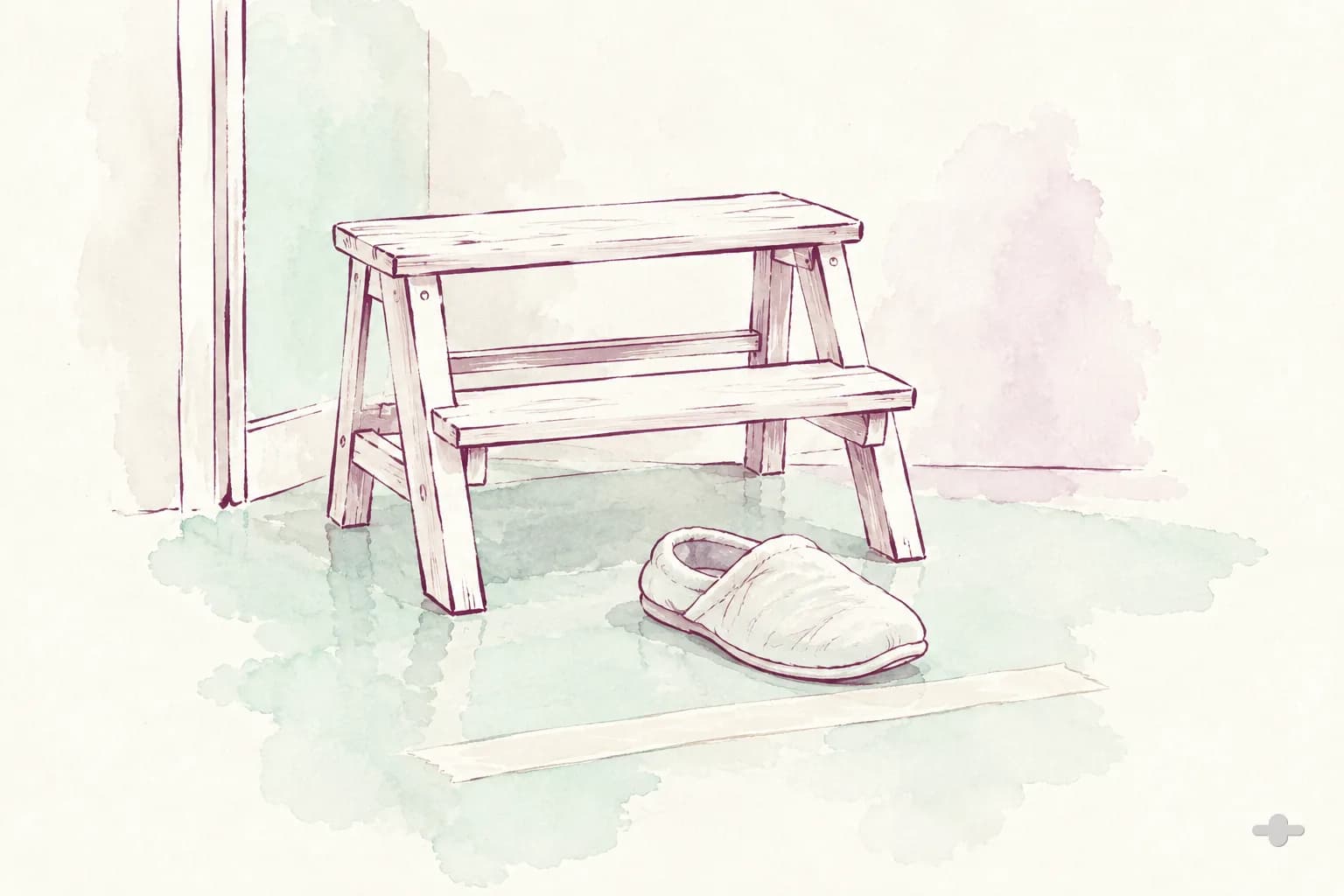
- Do not swap the slipper for a tissue box or anything taller or shorter: item 9 is scaled to a toe box.
- Re-test under the same conditions: same chairs, same step, same footwear, ideally the same rater. At minimum, test at admission and discharge.
The scale has one sitting item. If sitting balance is the goal, add a dedicated sitting measure, and if the problem shows up while walking, the gait side belongs in your gait training notes rather than in the Berg.
Berg balance scale scoring interpretation
A Berg total on its own is a measurement, not a verdict. The cut-offs below come from different samples with different designs, so quote the one whose population matches your patient, and name it in the note.
| Flags risk at | Population | Study and what it found |
|---|---|---|
| ≤ 50 | Community-dwelling older adults | Lusardi 2017, systematic review and meta-analysis. Named with TUG ≥ 12 s and 5× sit-to-stand ≥ 12 s as the best-supported performance measures; no single test showed strong post-test probability. |
| < 45 | Older adults | Berg 1992. The original validation: scores predicted multiple falls among elderly residents. |
| < 51 with a fall history, < 42 without | Community-dwelling older adults (n 44) | Shumway-Cook 1997. A two-factor model, BBS plus self-reported imbalance: sensitivity 91%, specificity 82%. |
| < 40 | Older adults | Shumway-Cook 1997, as summarised by the ANPT pocket guide. Associated with a fall risk close to 100%. |
No single test predicts a fall
The meta-analysis behind the ≤ 50 line found no single measure with strong predictive value on its own. Put the Berg beside the fall history, the medication list, the TUG or sit-to-stand time, and what you saw at home.
Many printable forms add a three-band split of the 56 points labelled wheelchair, walking with assistance and independent. That split is not part of the ANPT protocol. Use it, if at all, as a rough description, never as the fall-risk cut-off.
Normal Berg scores by age and sex
Independent, community-dwelling older adults score near the top. In the Steffen sample the means run from 55 in the sixties to 50 for women in their eighties.
| Age | Sex | n | Mean | 95% CI |
|---|---|---|---|---|
| 60–69 | Men | 15 | 55 | 55–56 |
| 60–69 | Women | 22 | 55 | 54–56 |
| 70–79 | Men | 14 | 54 | 52–56 |
| 70–79 | Women | 22 | 53 | 52–55 |
| 80–89 | Men | 8 | 53 | 51–54 |
| 80–89 | Women | 15 | 50 | 49–52 |
That clustering is the scale’s ceiling. An active sixty-year-old who scores 56 can still fall on a curb, and the Berg will not show her improving. When the deficit is balance while walking, the core-measures guideline points to the Functional Gait Assessment instead.
What counts as real change on a re-test
Same rater, two days, the same patient: the score moves a little without anything changing. The minimal detectable change (MDC) is the shift you need before calling it improvement. In older adults it depends on where the patient started.
4
points if first score 45–56
5
points if first score 35–44
7
points if first score 25–34
5
points if first score 0–24
118 older adults in physiotherapy, re-tested by the same rater within 48 hours (Donoghue and Stokes 2009). In older adults at risk of falling, Romero 2011 put the MDC at 6.5.
| Condition | MDC (points) |
|---|---|
| Stroke, acute | 6–7 |
| Stroke, chronic | 4.66–6.7 |
| Parkinson's disease, Hoehn & Yahr 1–4 | 5 |
| Huntington's disease, premanifest | 1 |
| Huntington's disease, early stage | 4 |
| Huntington's disease, middle and late stage | 5 |
A three-point gain is a good week. It is not yet a finding.
Write the goal so it clears the MDC for your patient’s band. A goal that asks for less than the measurement error can be met by chance, and a reviewer reading the progress note knows it.
Writing the Berg into the note
The Berg belongs in the objective section, as a total with its denominator and the items that cost the points. The items are what make it useful to the next clinician: a patient who drops points on tandem stance and single-leg stance needs different work from one who drops them on transfers.
O: BBS 46/56, no device. Points lost on forward reach, looking behind, 360° turn, alternate step, tandem stance and single-leg stance (item 14 scored 1: lifts the leg, cannot hold it).
A: Inside the Lusardi 2017 fall-risk range (≤ 50) for community-dwelling older adults; outside Berg 1992 (< 45). Deficits in narrow-base and single-limb control.
Goal: BBS ≥ 51/56 in 6 weeks: clears the MDC of 4 points for a first score of 45–56 and leaves the ≤ 50 range.
The pattern is the same one our SOAP note example uses for range of motion: the number, what limited it, and the re-test date in the plan. The plan of care builder takes the goal line as written, and the documentation templates show where it repeats in the progress note and the discharge summary.
The deficits the Berg names are what justify the treatment that follows. Narrow-base and single-leg work aimed at a measured control deficit is the case for CPT 97112, neuromuscular re-education, and the Berg total is the measured finding that note needs.
Billing: the test usually rides inside the visit
In most outpatient notes the Berg is part of the examination, so it is documented inside the evaluation (97161–97163) or the re-evaluation (97164), where it counts toward the evaluation elements. Whether a payer will pay for it as a separate measured test is a question for that payer’s policy, asked before the claim goes, not after.
Quick reference
Protocol, cut-offs and change values read on 2026-10-22 from the ANPT core-measure documents, the Shirley Ryan AbilityLab Rehabilitation Measures Database and the cited journals. The item levels are our own short wording; the Berg Balance Scale is Katherine Berg’s instrument. This page explains a measure and is not medical advice. CPT is a trademark of the American Medical Association.
Sources
- Academy of Neurologic Physical Therapy — Core Measure: Berg Balance Scale (BBS) — the 14 items, standardized instructions, scoring, equipment and FAQs · read 2026-10-22
- ANPT Core Measures — Berg Balance Scale pocket guide — cut-off scores and MDC by condition · read 2026-10-22
- Moore JL et al. A Core Set of Outcome Measures for Adults With Neurologic Conditions Undergoing Rehabilitation. J Neurol Phys Ther. 2018;42(3):174-220 · read 2026-10-22
- Shirley Ryan AbilityLab — Rehabilitation Measures Database: Berg Balance Scale — Berg 1992 and Shumway-Cook 1997 cut-offs; Steffen 2002 age and sex norms · read 2026-10-22
- Lusardi MM et al. Determining Risk of Falls in Community Dwelling Older Adults. J Geriatr Phys Ther. 2017;40(1):1-36 · read 2026-10-22
- Shumway-Cook A et al. Predicting the probability for falls in community-dwelling older adults. Phys Ther. 1997;77(8):812-819 · read 2026-10-22
- Steffen TM et al. Age- and gender-related test performance in community-dwelling elderly people. Phys Ther. 2002;82(2):128-137 · read 2026-10-22
- Donoghue D, Stokes EK. How much change is true change? The minimum detectable change of the Berg Balance Scale in elderly people. J Rehabil Med. 2009;41(5):343-346 · read 2026-10-22
- Romero S et al. Minimum detectable change of the Berg Balance Scale and Dynamic Gait Index in older persons at risk for falling. J Geriatr Phys Ther. 2011;34(3):131-137 · read 2026-10-22
- American Medical Association — Current Procedural Terminology (CPT) — CPT is an AMA trademark; the official descriptors are the AMA's and are paraphrased here, never reproduced · read 2026-09-04
Keep reading
Home exercise program software
What HEP software buys you, the published prices, and why adherence decides.
Home exercise program builder
Build a printable home programme with sets, reps, holds and band tension.
Normal range of motion chart
Normal ROM by joint and plane, with the measured value scored against it.
Occupational therapy vs physical therapy
What each treats, the degree each needs, pay, and how Medicare bills them apart.
Published 2026-10-22 · reviewed 2026-10-22