Cervical range of motion norms
2026-09-04 · 7 min read
Four motions, four reference numbers, and one rule that matters more than any of them: compare the patient with themselves before you compare them with a population.
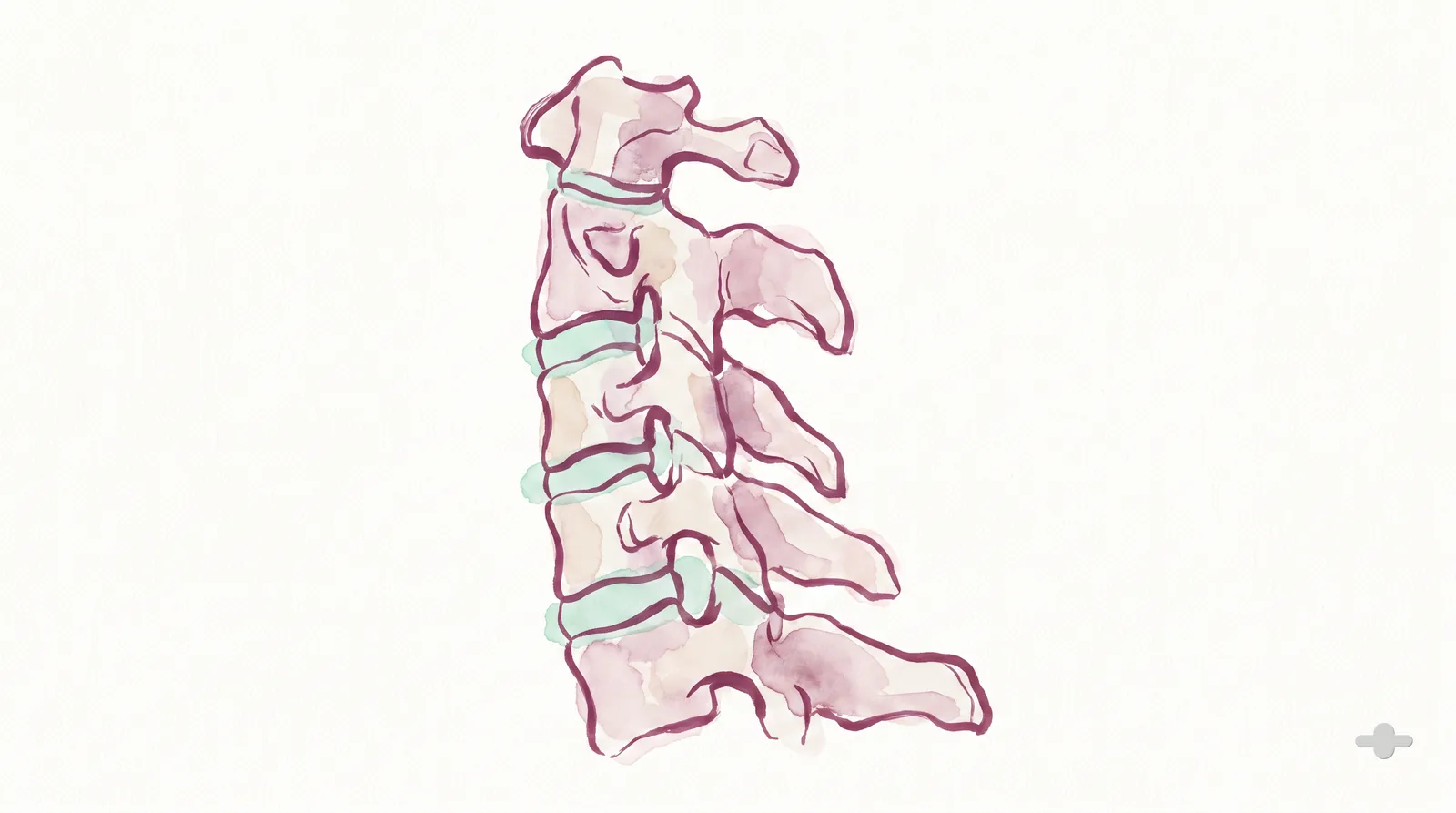
The reference numbers
| Motion | Reference | Watch for |
|---|---|---|
| Flexion | 45° | Chin towards chest; the thoracic spine must stay still |
| Extension | 45° | The motion most often limited after a whiplash mechanism |
| Rotation | 80° | Measured seated, crown of the head as the axis |
| Side-bending | 45° | Ear towards shoulder without the shoulder rising |
Reference ranges, not pass marks
Reference values below are the AAOS figures as reproduced in Norkin & White, Measurement of Joint Motion: A Guide to Goniometry. Published sources differ by roughly 5–10° at several joints; the AMA Guides use a partly different set. Treat them as reference ranges, not pass/fail cut-offs.
Measuring them
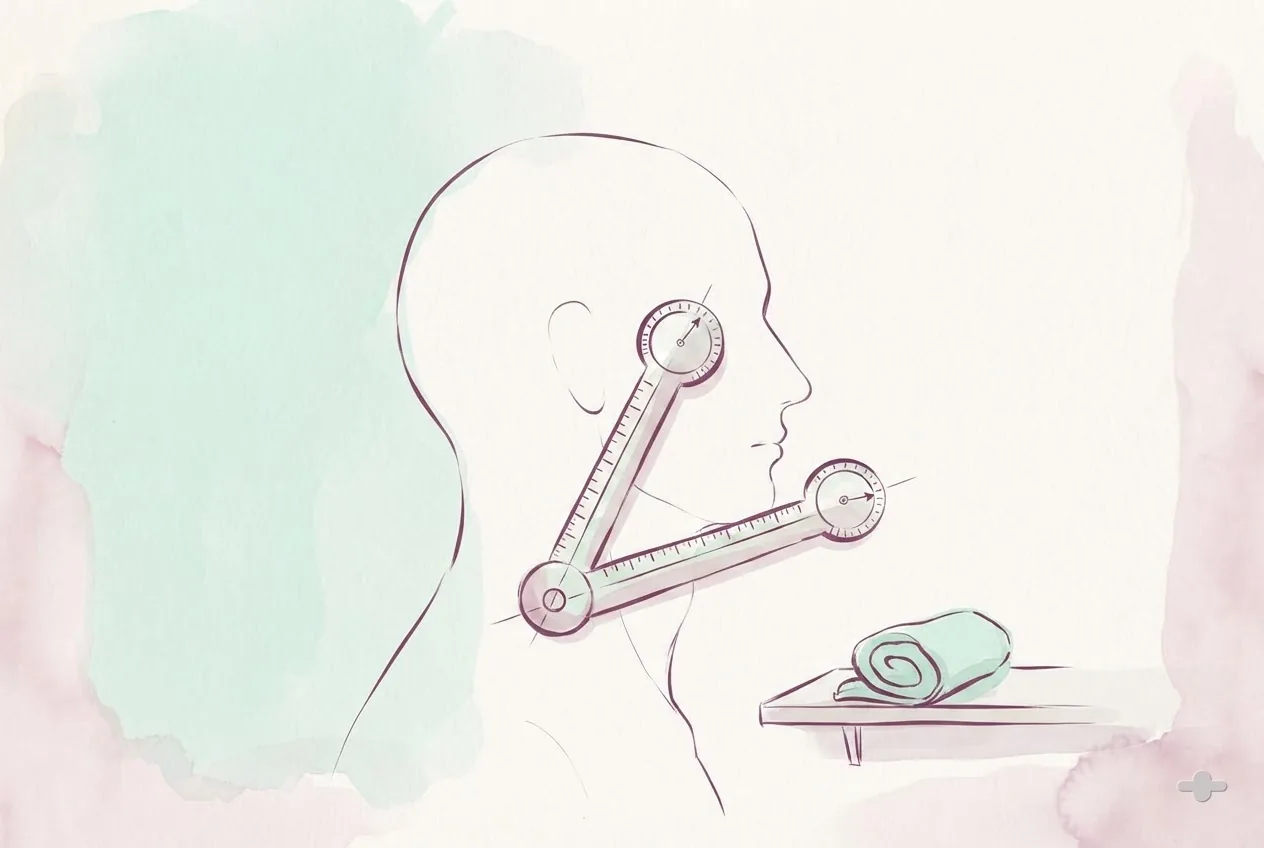
Seat the patient with their back supported and their feet on the floor. Cervical range measured in standing borrows from the trunk within two repetitions.
For rotation, the axis is the crown of the head and the reference arm points along the sagittal plane; for flexion and extension the axis is the external auditory meatus. Write down which landmark you used — half the disagreement between two clinicians is landmark drift, not patient change.
An inclinometer is easier than a goniometer for flexion and extension and no less repeatable, provided the same instrument is used at re-test.
What a limitation means
A single restricted motion with a hard end-feel points at the joint. A symmetrical global restriction with a soft end-feel points at muscle guarding, and it usually moves within one session. Rotation limited on one side by more than about ten degrees against the other is the pattern most worth acting on, because it is both measurable and responsive.
Rotation is also the motion patients notice, because it is the one they use to reverse a car. Tie the goal to that rather than to the number.
Tell the patient the goal in the motion they miss, not in degrees — turning far enough to reverse the car is a target; forty-five degrees is a note.
Tracking it
A pre and post reading on the same visit is the cheapest evidence of effect in the clinic. It takes ten seconds and it converts an assessment sentence from an assertion into a measurement.
Record both sides every time, not just the restricted one. The uninjured side drifts too, and an episode where both sides improved by the same amount is telling you something about the measurement rather than about the neck.
Related: the full ROM chart, the measurement guide, the neck programme.
Red flag — refer out
A range that worsens against treatment, or a sudden loss with pain out of proportion to the mechanism, is not a measurement problem. Stop measuring and refer.
Empirical adult values by age and sex: Soucie JM et al. Range of motion measurements: reference values and a database for comparison studies. Haemophilia. 2011;17(3):500-507 — the CDC-funded normal joint ROM study, which measured healthy subjects by age and sex.
Sources
- Norkin CC, White DJ. Measurement of Joint Motion: A Guide to Goniometry — the AAOS reference values as reproduced there; published sources differ by roughly 5–10° at several joints
- Soucie JM et al. Range of motion measurements: reference values and a database for comparison studies. Haemophilia. 2011;17(3):500–507 — the CDC-funded normal-ROM study, measured by age and sex · read 2026-10-18
Keep reading
Hip range of motion norms
Hip flexion, extension, abduction and rotation norms, and how to measure them.
Lumbar range of motion norms
Lumbar flexion, extension and lateral bending, plus the Schober alternative.
Upper extremity range of motion norms
Shoulder, elbow, forearm, wrist and hand norms in one reference table.
Athletic trainer vs physical therapist
Degree, exam, settings, pay and Medicare billing, and where the two hand off.
Published 2026-09-04 · reviewed 2026-09-04